


Ediscovery Search Facilities
As design owner of Ediscovery search facilities, I shipped value against a unique blend of domain and technical constraints. This study breaks down my high-level work and impact in this role, which continues to drive tens of millions in sales.
About this case study
This case study is distinct from others because it focuses on breadth over depth to communicate broad impact in my role as lead designer of Ediscovery search facilities. The work described here is underpinned by its own research, discovery, and cross-functional collaboration. For in-depth examples of my design process, check out my other case studies.
Case study contents
Shaping strategy, not just creating artifacts
Operating as a strategic design partner
Developing and disseminating product vision
Shaping vision, managing relationships, driving alignment
Initiative Example: Search Term Report Hit Attribution
Extending mass search throughout the platform
Example motivators for experimental innovation
Explorations shaped by long-term thinking
Constant collab
Drove meetings where they were needed; drove asynchronous collab where possible
Long-term strategic planning
Worked with Product and Engineering leaders to identify market opportunities, organize our shared vision against constraints, and establish accountability metrics
80%
of 2025 research sessions involved eng
Dev attendees
Regular readouts
Followup discussions
Research shaped by eng input
"Joe communicates design decisions effectively across settings, matching level of detail to the audience."
Ownership
Drove collaborative weekly planning, strategy, and leadership updates with product trio
Firm Partner
Attorney
Ediscovery Lead
Lit Support
Visible research
Empowered the team with research readouts
Shaping strategy, not just creating artifacts
I've been in the design game for over a decade, with strong opinions loosely held. I'm not a pixel and prompt pusher—I help shape profitable strategy, then execute against it. Design is my vehicle for driving change.
Alignment > consensus
I have immense respect for the user and my cross-functional partners. So when competing interests create tension, I'm not a passive collaborator. I feel a strong sense of ownership, and prefer to work closely with product and engineering to resolve conflict. Often we achieve consensus. Sometimes we settle for disagreement with commitment. This isn't about ego—it's about driving the right product outcomes so that everyone can win in the long run.
Relationship-based design influence
I identify the overlaps in team goals to illustrate how a shared product vision helps everyone win. I work in service of those common interests, including with teams outside the product org.
Asking the hard questions
and challenging others to think beyond the feature
Driving consensus
or disagreeing and committing anyway
Developing and disseminating product vision
I think beyond features, working with teams to shape a vision they actually care about. I practice relationship-based design, organized around common goals. I start with research and bring others along to craft a shared vision, then blend it with our day-to-day to help teams feel invested in vision that actually feels attainable and exciting.
Some things can't be shared
Although I can't share specifics about this product's vision, let's chat about the process of shaping and sharing vision, managing stakeholder relationships, and driving alignment even when there isn't full consensus.


New Search Filter Depth
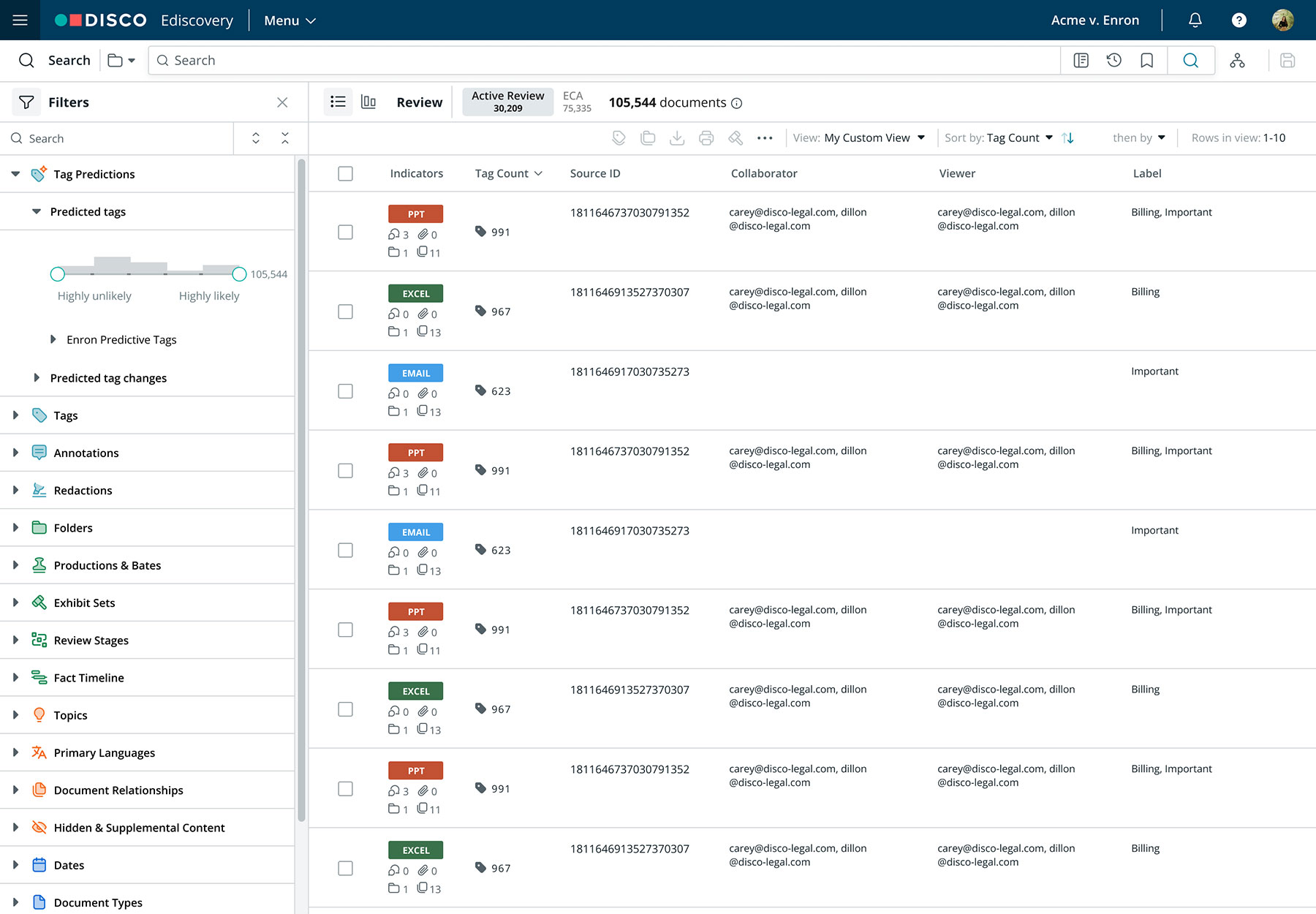
Designed stateful and powerful new filters, expanding established functionality to offer nuanced STR hit assessment in the primary doc list

Updated exports
Supported DLE workflows

STR Columns in the Doc List
Brought STR insights 'home' to the primary doc list, surfacing context amid complex, high-density data
"It's amazing to see which terms my docs are responsive to. And vice versa."
Initiative example: Search Term Report Hit Attribution
Hit Attribution is one example of my work in this role. Check out other case studies for more detailed project case studies. Search Term Reports enable asynchronous mass search across millions of documents. Historically, they were isolated from other facilities. This work extended previous enhancements to surface actionable, contextual STR hits throughout the broader platform.
Project process
My design process here was non-linear because of the nature of the work. I inherited some discovery to build upon, taking up the mantle with self-directed research to bring the feature to the next level. Being new to the Search team, I focused on deep cross-functional collaboration to check my assumptions and support my own search mastery and vision development alongside feature work.
Why it matters
At its core, DISCO Ediscovery is a search and review platform that helps litigators manage high volumes of material data. STRs are a powerful way to orchestrate searches, made dramatically more useful by this work to surface STR context throughout Ediscovery.
Some things can't be shared
Although I can't share more details about the design of this feature, I'm happy to discuss my general approach to complex feature design, and the cross-functional collaboration it demands.
How might we…
Solve cardinality issues at scale...
…with a system housing hundreds of millions of documents?
Evolve legacy search facilities...
…with powerful new technologies like natural language conversion, or smarter automatic categorization?
Integrate new AI search patterns...
…given extensive search facilities with wide surface area?
Educate non-technical users...
…about the power of a custom query language that otherwise feels inaccessible to most reviewers?
Enhance OOTB search...
…using historically overlooked education mechanisms, like templates or a recommendation engine?
Evolve doc grouping structures...
…to better accommodate how modern legal teams actually conduct legal review?
Example motivators for experimental innovation
Most design work isn't linear. I drove product exploration around cutting-edge search concepts, shaped by recurring internal and external feedback loops. These are examples of the types of problems I solved for, in service of more efficient legal outcomes for users.
Naturally, some things can't be shared
Although I won't share unreleased feature explorations, I'd love to chat about my general approach to proactive experimentation in design — and the role that it plays in healthy long-term product strategy.